
Medieval Neon
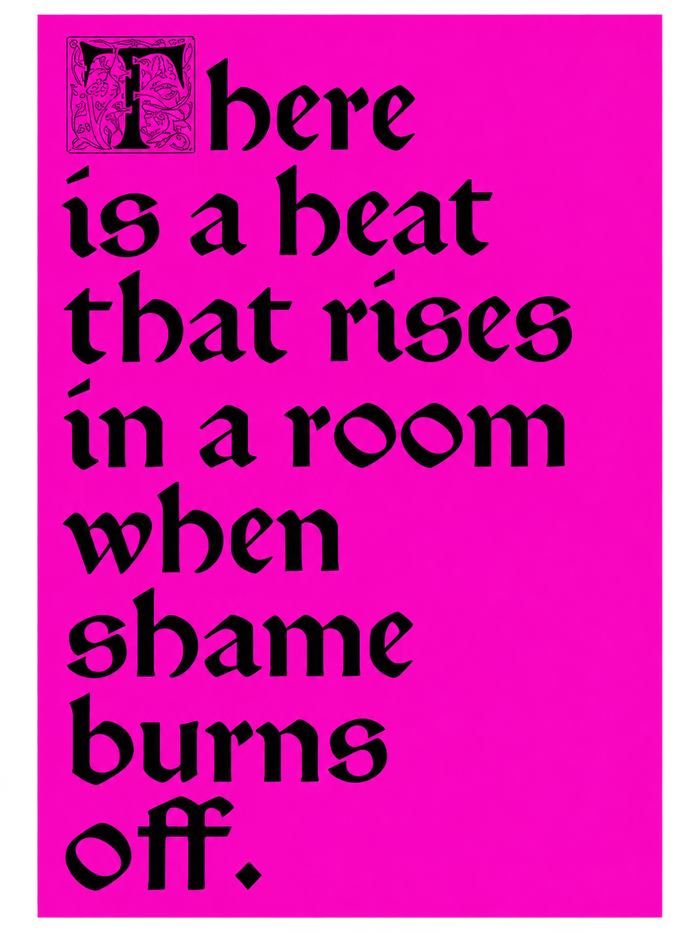
Medieval Neon brings together the language of courtly literature and the visual grammar of contemporary advertising. The work takes a line translated from medieval French by William Morris in The Tale of King Florus and the Fair Jehane — “There is a heat that rises in a room when shame burns off” — and relocates it onto fluorescent paper, printed in an edition of one hundred. In doing so, the print collapses the distance between the medieval and the modern, revealing shame as a social force that persists across centuries.
The original phrase speaks of exposure and transformation: shame leaving the body like heat escaping a confined space. In Medieval Neon, that heat becomes literalised through colour and surface. The neon stock evokes warning signs, discount posters, high-visibility workwear and the aggressive palette of consumer culture. It is a material associated with visibility — with being seen — and this is central to the work’s tension. Poverty, in the print, is not only an economic condition but a condition of surveillance.
The work is concerned with the shame produced when poverty becomes legible to wealth. The “room” of the text becomes social space itself: the gallery, the shop floor, the benefits office, the rented flat, the workplace. Heat rises when concealment fails. The poor are compelled to manage appearances constantly, to soften or disguise evidence of precarity before the gaze of those protected from it. The burning off of shame is therefore ambiguous. It may suggest liberation, but it also implies exposure, in the painful moment when dignity can no longer be privately maintained.
By using a medieval text, the print refuses the idea that poverty shame is uniquely contemporary. The emotional architecture of class ; humiliation, performance, concealment, judgement, stretching historically across feudal and capitalist worlds alike. Yet the neon surface pulls the work sharply into the present, where visibility itself has become intensified through branding, media and spectacle. The print behaves almost like an illuminated advertisement, but instead of selling aspiration it exposes the psychic cost of inequality.
The edition of one hundred further complicates the work. Repetition echoes both the reproducibility of printed propaganda and the repeated social experience of shame under class society. Each print carries the same sentence, as though the feeling described is endlessly circulating between bodies and generations.
In Medieval Neon, language acts both as confession and warning. The work transforms an inherited literary fragment into a contemporary class statement: shame is not private weakness, but a heat generated by unequal social relations and by the violence of being seen, ignored and forgotten.
Digital print on pink day glo neon gig paper
29.7 x 42cm
Edition of 100
Available for order by post at https://thesecondacteditions.co.uk/products/medieval-text